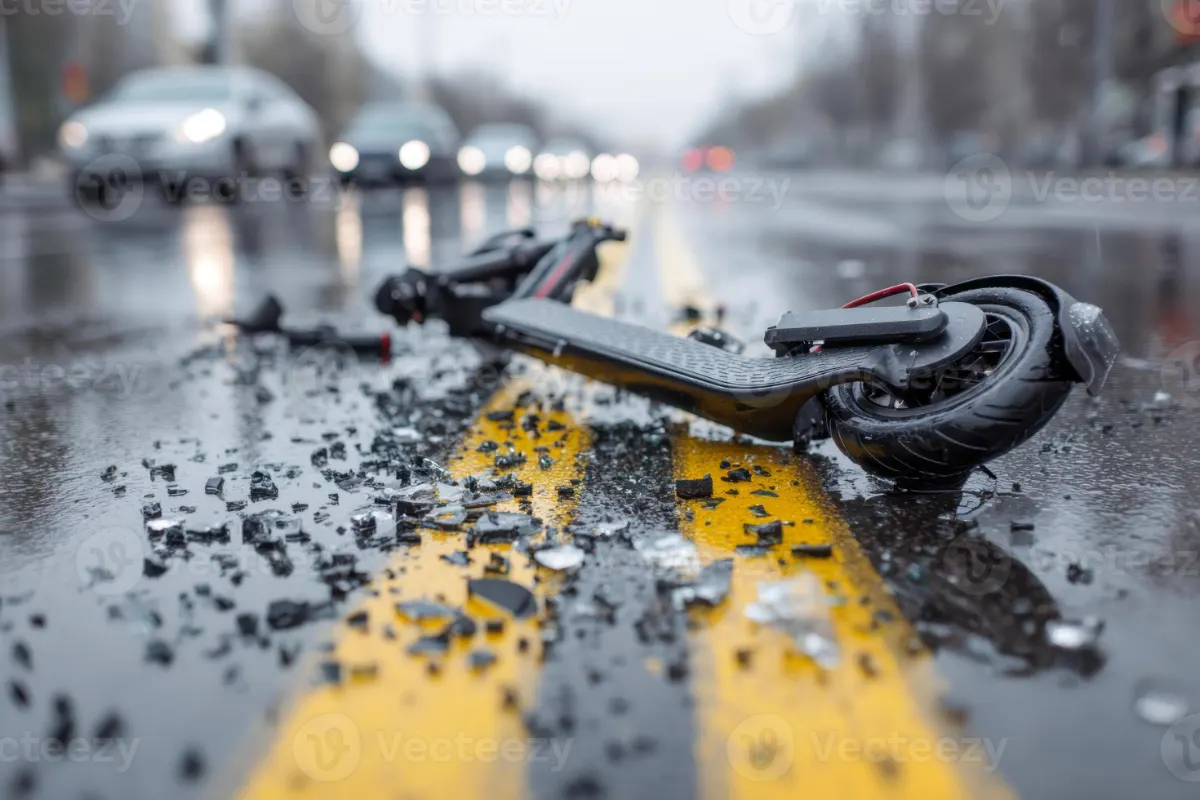
San Diego Truck Accident
Khashayar Law Group, top San Diego truck accident attorneys, secured a $5,000,000 policy-limits settlement in a serious truck-versus-scooter collision
The Case: $5 Million Policy-Limits Settlement After a Contested Police Report
Khashayar Law Group, top San Diego truck accident attorneys, secured a $5,000,000 policy-limits settlement in a serious truck-versus-scooter collision — even after the police report placed 100% of fault on our client and the defendants refused to pay a single dollar. This case illustrates why injured clients across California trust the firm as one of the best truck accident attorneys in San Diego.
What Happened
Our client, a scooter rider, was severely injured in a collision with a commercial truck. The initial police investigation concluded the rider was 100% at fault and the police report reflected that finding. The defendants and their insurer refused liability, citing the report.
Our client was transported by ambulance to the emergency room and required extensive treatment and rehabilitation. He suffered chronic pain, limited mobility, lasting emotional trauma, and was left wheelchair-bound for an extended period. The injuries disrupted his ability to work and carry out daily activities, requiring ongoing care.
How We Won
Khashayar Law Group’s trial-experienced attorneys did not accept the police report as the final word. Our team took multiple depositions, including those of the police officers at the scene, ultimately getting the officers to acknowledge they had made mistakes in the report and the underlying investigation. We established that the truck driver had driven into the bike lane, even though our client was riding the wrong direction at the time.
After more than two years of litigation and on the eve of trial, the defendants agreed to pay the full $5,000,000 policy limits. The result demonstrates a principle California truck accident victims need to understand: a police report is admissible evidence, but it is not conclusive. Liability is decided on the full evidentiary record — depositions, vehicle data, scene reconstruction, and witness testimony — not on the responding officer’s initial conclusion.
Why This Result Matters for Other California Truck Accident Victims
Many injured people are told by insurers, friends, or even other attorneys that an unfavorable police report ends the case. It does not. Under California’s pure comparative negligence rule (California Civil Code §1714), an injured plaintiff can recover even when partially at fault — and a police report’s assignment of fault is not binding on a jury. A truck accident case turns on what the underlying evidence actually shows, not on what a first responder wrote in a one-page summary.
Understanding Truck Accidents in California
The Four Main Types of Truck Accidents
Truck accidents fall into four primary categories based on crash mechanics. Each type produces distinct injury patterns and liability questions:
- Jackknife — the trailer swings outward at an angle to the cab, typically after sudden braking on slippery surfaces, sweeping across multiple lanes.
- Rollover — the truck tips onto its side or roof, most often during sharp turns or when cargo shifts mid-route.
- Underride — a smaller vehicle slides beneath the truck’s trailer, with the trailer edge contacting the passenger compartment. Among the most catastrophic crash types.
- Override — the inverse: the truck rides over a smaller vehicle after a collision. Standard vehicle safety systems cannot absorb the forces involved.
Identifying the crash type early in an investigation matters because it narrows the range of equipment, driver actions, and maintenance records that become relevant to liability.
What Causes Most Truck Accidents
The federal Large Truck Crash Causation Study (LTCCS), conducted by the Federal Motor Carrier Safety Administration, identified driver error, vehicle defects, and environmental conditions as the three primary contributing factors in large truck crashes — with most collisions involving a combination of factors rather than a single cause.
- Driver-related causes — speeding, fatigue, distraction, impaired judgment, hours-of-service violations.
- Vehicle-related causes — brake failures, tire blowouts, coupling device defects, inadequate maintenance.
- Environmental causes — road hazards, poor visibility, adverse weather.
The multi-factor reality matters legally: liability may be distributed across the truck driver, the trucking company, a maintenance contractor, a cargo loader, or the vehicle manufacturer, depending on which negligent act or defect most contributed to the outcome.
Why Truck Accident Injuries Are More Severe
A loaded semi-truck can weigh up to 80,000 pounds, while a typical passenger car weighs 3,000 to 4,000 pounds. When those two vehicles collide, the passenger vehicle absorbs a disproportionate share of the force. Occupants in smaller vehicles face elevated risks of spinal cord injury, traumatic brain injury, amputation, and death. These outcomes drive higher medical costs, longer recovery timelines, permanent disabilities, and lost earning capacity — all of which raise the damages a plaintiff can claim.
California Trucking Regulations and Liability
FMCSA Hours-of-Service Rules
Commercial truck drivers operating in interstate commerce are governed by the Federal Motor Carrier Safety Administration. Under 49 CFR §395, drivers may not operate more than 11 hours after 10 consecutive hours off-duty, may not drive after 14 hours on-duty, and must take a 30-minute break after 8 cumulative hours. Electronic logging devices record every minute. Hours-of-service violations are documented in a significant share of fatal truck crashes and are a frequent driver of trucking-company liability.
Who Can Be Liable in a California Truck Accident
Liability in a truck accident depends on identifying which party’s negligence or equipment failure caused the crash. The accident type alone does not assign fault. Multiple parties can share liability in a single collision:
- The truck driver — for negligent operation, fatigue, distraction, intoxication, or unsafe lane changes.
- The trucking company — vicariously under California’s respondeat superior doctrine, and independently for negligent hiring, inadequate training, scheduling pressure, or failure to enforce FMCSA hours-of-service rules.
- The cargo loader — if improper loading caused a rollover or cargo spill.
- The vehicle manufacturer — if a defective component (brake, tire, steering, coupling, underride guard) contributed to the crash.
- Maintenance contractors — when a known defect was not properly repaired before the crash.
Tracing specific conduct or equipment failure to crash causation requires preserving electronic logging data, maintenance records, and driver qualification files quickly — trucking companies are not required to retain those records indefinitely.
The Two-Year California Statute of Limitations
Under California Code of Civil Procedure §335.1, the statute of limitations for personal injury claims from a truck accident is generally two years from the date of injury. If a government vehicle, government driver, or public road defect contributed to the collision, California Government Code §911.2 requires a written government claim within six months. Missing these deadlines ends the right to recover regardless of how strong the underlying evidence may be.
Pure Comparative Negligence in California
California follows pure comparative negligence under Civil Code §1714. A plaintiff can recover damages even when partially at fault — recovery is reduced by the plaintiff’s percentage of fault, not eliminated. For example, a plaintiff found 20% at fault on a $1,000,000 claim can still recover $800,000. This is why the $5,000,000 truck-versus-scooter settlement was possible even though the police report originally assigned 100% of fault to our client: the legal standard does not stop at the police report.
Frequently Asked Questions
Can I win a truck accident case if the police report says I am at fault?
Yes. In California, a police report is admissible evidence but not conclusive. Khashayar Law Group secured a $5 million policy-limits settlement despite an initial police report placing 100% fault on the client, after establishing the truck driver had driven into the bike lane.
What is the statute of limitations for a truck accident claim in California?
Under California Code of Civil Procedure §335.1, the statute of limitations for personal injury claims from a truck accident is generally two years from the date of injury.
Who can be held liable in a San Diego truck accident?
Multiple parties can be liable: the truck driver, the trucking company (for negligent hiring or FMCSA hours-of-service violations), the cargo loader, and the vehicle manufacturer.
What is pure comparative negligence in California truck accident cases?
California follows pure comparative negligence (Civil Code §1714), meaning a plaintiff can recover damages even if partially at fault. Their recovery is reduced by their percentage of fault — e.g., if found 20% at fault on a $1M claim, they can still recover $800,000.
Contact Khashayar Law Group — San Diego Truck Accident Attorneys
Khashayar Law Group handles serious truck accident, commercial vehicle, and pedestrian injury cases throughout San Diego and California. If you’ve been injured in a collision involving a truck — even when fault is contested or the police report goes against you — contact our San Diego personal injury attorneys for a free consultation. Call (858) 509-1550 or visit our office at 1350 Columbia St., Suite 303, San Diego, CA 92101.
Case record
Result: $5,000,000 settlement
Case type: Truck versus scooter collision (policy-limits settlement)
Resolution: Firm-reported settlement
Parties: confidential
Firm: Khashayar Law Group, Daryoosh Khashayar, founder
Verification: This result is firm-reported. See our editorial policy for how results are classified and verified.
Source note. This is a firm-reported settlement. Settlement details may be confidential, and not every settlement has a public case number or public verdict report.
Past-results disclaimer. Past results do not guarantee or predict future outcomes. Every case depends on its facts, evidence, defendants, insurance coverage, venue, applicable law, and litigation strategy.
We're here to listen, guide, and support.
Angela Ness